Events this week have shown an about-face, proving challenges are ever changing. Example: from being given information that cancer cells were not running amok, to being informed that those errant cells are indeed attaching and growing inside my bones. Two weeks ago, a CT scan showed no problem, but a previous MRI indicated some suspicious areas of clustering cells congregating under my left arm and under the implant where I once had a breast. Then a new day dawned and a PET scan performed Tuesday showed lesions on the lower spine, the upper pelvis and also deep under the left rib, thinning the bone and causing havoc with nighttime sleep and daytime movement. Liken the discomfort unto a bruised rib. Kind of.
Yesterday, prayers from family and friends and a helpful technician giving me extra doses of fentanyl helped me breeze through two bone core biopsies in my upper pelvis. Now we wait for the definitive news from pathology to tell that sorry old story that breast cancer has spread to the bones.
Several days ago I read this poem by Jo McDougalk, published by The Writer's Almanac on July 12. It reverberated in my chest wall.
CHOICE
You’ve come to the oncologist’s office
to talk about your options.
You view the scans,
forgetting to breathe.
“It’s metastasized.” He frowns,
pointing to where and where.
He ticks off the preferred treatment,
the side effects,
low rates of success.
“It’s your choice,” he says,
closing your folder,
“but we need to start tomorrow.”
You think of yesterday
when you lived in a different universe,
of a waitress,
hand on her hip, asking,
“Hon, you want mustard or mayo
on that sandwich?”
Chew on that one. Some choices are mundane, a few are critical. Time will tell, and decisions will be made with prayer and the Holy Spirit backing us up.
While meditating this morning, Psalms 91 came to mind. (Joyce Meyer has a great sermon about Psalms 91 on YouTube here). These are the first two verses in the scripture, but read the entire psalm for comfort.
He that dwelleth in the secret place of the most High shall abide under the shadow of the Almighty. I will say of the LORD, He is my refuge and my fortress: my God; in him will I trust. (Psalms 91:1-2)
photo by Carol Lewis
I am trusting and desiring to be a good example of dealing with cancer in a realistic and God centered manner so that I can give Julie that as a legacy. My mother did the same for me in 2000 when she dealt with the cancer issue, and was never fearful of one day following the next. Nor am I, and I trust that Julie will also face her own mortality with faith and dignity. Next posting with be all about knitting, I promise.
During the session last night at our weekly RCIA class, we were asked to write how activities of the past week had affected us in terms of our spirituality. Here were my thoughts: Several times over the past week I have said that Passion Week was difficult for me. Instead of being one of the Risen People, I have felt inadequate, shamed by my lack of compassion with Julie. Yes, I have spent time with her, but that root feeling of impatience in doing things for her has come over me too many times. Too often I have felt anger, pity, judgment and frustration. Instead of acting out of love, I have been quick to jump into areas not within my realm of understanding.
That written, I was caught again by one of Richard Rohr's meditations. Just today, I read these thoughts found here.
We Christians are such a strange religion! We worship this naked, bleeding loser, crucified outside the walls of Jerusalem, but we always want to be winners, powerful, and on top ourselves . . . at least until we learn to love the little things and the so-called little people, and then we often see they are not little at all, but better images of the soul.
Yes, those with mental and physical disabilities, minority groups, LGBTQ folks, refugees, prisoners, those with addictions--anyone who's "failed" in our nicely constructed social or economic success system--can be our best teachers in the ways of the Gospel. They represent what we are most afraid of and what we most deny within ourselves. That's why we must learn to love what first seems like our "enemy"; we absolutely must or we will never know how to love our own soul, or the soul of anything. Please think about that until it makes sense to you. It eventually will, by the grace of God.
I simply need to shut my mouth. And listen. And act from love. And learn to accept my enemy, my own unworthy soul. And just maybe I will learn the lesson, by the grace of God.
The most important lesson is this:
God chose things the world considers foolish in order to shame those who think they are wise. And he chose things that are powerless to shame those who are powerful.
--1 Corinthians 1:27
Happenings at Immaculate Heart of Mary Catholic Church last week:
Abbreviated Rosary (called a decade rosary, made of ten repetitions) hand made by my sponsor, Ramana. She made this and gave it to me at Easter Vigil late Saturday evening. The cross she made is that of St. Brigid of Ireland, my chosen patron saint. I think it is beautiful.
Ramana is shown in photo below, right, when she sponsored me at my confirmation into the Catholic Church on December 19, 2015.
It arrived at Stonehenge and here, too. The light is mighty short.
"And God said, Let there be lights in the firmament of the heaven, to separate the day from the night, and let them be for signs, and for seasons, and for days, and years. And let them be for lights in the firmament of the heaven to give light upon the earth: and it was so. God then made two great lights: the greater light to rule the day, and the lesser light to rule the night: He made also the stars. And God set them in the firmament of the heaven, to shine upon the earth. And to rule in the day, and in the night, and to separate the light from the darkness: and God saw that it was good. So the evening and the morning were the fourth day."
Suppose your whole world seems to rock on its foundations; let it rock, and when the rocking is over, the picture will have reassembled itself into something much nearer to your heart's desire.
----From The Seven Day Mental Diet by Emmet Fox
From Why, O Lord?.....
I have known that if I want to be happy on earth I must fall madly in love with God and the things of God.
Then, all things being equal, in time of suffering the easiest way to allay the suffering, especially if it is really sharp, is to get out of myself - yes, get out of myself; visit someone who is suffering worse than I am, do something to remind me of the sufferings of the world, set my heart in order if I feel a residual dislike of someone, write a cheque for the world's poorest mission, answer a tiresome letter from someone who wants me to tell him whether hell exists, or what he should not do to leave his nasty possessive wife.
In other words, perform an act of love that requires patience and honesty. .... Carlos Caretto
One of my favorite Christian authors, Fredrick Buechner, writes of the advent season in a personal manner that sets me pondering on thoughts sometimes outside the usual realm of a spiritual Christmas. He writes about the ugliness in me (yes, I personalize that ugliness for it is in me, not necessarily in you).
Buechner talks about our faults, our sinful ways, our selfishness, our arrogance. He has a way of revealing all our human flaws, yet reminding us that God actually loves us. And that every fault in our beings that is wrong, just wrong, is most certainly known by God. But He keeps on loving us because grace is there, a present, a real Christmas present, that He gives us just for the asking.
With over thirty books written by Buechner (link here to his website), he has a way of unveiling grace to us, making it alive even in our somewhat sin-disguised and tawdry lives.
Episcopalian Rev. Barbara Taylor Brown said in a speech what fans of Buechner have always believed about his writings:
From you, I have learned that language itself is revelatory, with power to ignite hearts, move mountains, and save lives.
From you, I have learned that the good news is not the cheerful news but the dismantling news of what it is like both to love and to betray the Holy One who has given me life, only to hear the saving question asked anew, for the umpteenth time, “You, you child of mine, Do you love me?”
This is what Christmas is about: the opening up of God's love to me, even me. Such a powerful present, and it is there just for the asking. Imagine.
The house lights go off and the footlights come on. Even the chattiest stop chattering as they wait in darkness for the curtain to rise. In the orchestra pit, the violin bows are poised. The conductor has raised his baton.
In the silence of a midwinter dusk there is far off in the deeps of it somewhere a sound so faint that for all you can tell it may be only the sound of the silence itself. You hold your breath to listen.
You walk up the steps to the front door. The empty windows at either side of it tell you nothing, or almost nothing. For a second you catch a whiff in the air of some fragrance that reminds you of a place you've never been and a time you have no words for. You are aware of the beating of your heart.
The extraordinary thing that is about to happen is matched only by the extraordinary moment just before it happens. Advent is the name of that moment.
The Salvation Army Santa Claus clangs his bell. The sidewalks are so crowded you can hardly move. Exhaust fumes are the chief fragrance in the air, and everybody is as bundled up against any sense of what all the fuss is really about as they are bundled up against the windchill factor.
But if you concentrate just for an instant, far off in the deeps of you somewhere you can feel the beating of your heart. For all its madness and lostness, not to mention your own, you can hear the world itself holding its breath.
It is Advent. I am enjoying my candles, my Mother and Child icons, and perhaps holding my breath, just a little. And opening up that present called "grace".
Join with Angela and others in blogging about Advent. Here is the link.
A pilgrim on a pilgrimage Walked across the Brooklyn Bridge His sneakers torn In the hour when the homeless move their cardboard blankets And the new day is born Folded in his backpack pocket The questions that he copied from his heart Who am I in this lonely world? And where will I make my bed tonight? When twilight turns to dark
Questions for the angels Who believes in angels? Fools do Fools and pilgrims all over the world
If you shop for love in a bargain store And you don't get what you bargained for Can you get your money back? If an empty train in a railroad station Calls you to it's destination Can you choose another track? Will I wake up from these violent dreams With my hair as white as the morning moon?
Questions for the angels Who believes in angels? I do Fools and pilgrims all over the world
Downtown Brooklyn The pilgrim is passing a billboard That catches his eye It's Jay-Z He's got a kid on each knee He's wearing clothes that he wants us to try
If every human on the planet and all the buildings on it Should disappear Would a zebra grazing in the African Savannah Care enough to shed one zebra tear? Questions for the angels
It now being the early morning of Thanksgiving Day in the USA, it came to mind the phrase "thank the Lord". I can clearly hear my grandmother saying those words even though it has been three decades since she has gone to her eternal reward. Mom usually said that phrase in an off-the-cuff manner and, most often, in such a quiet tone that only she was meant to hear.
So now, thank the Lord, I am sitting in a warm house, in front of a cozy fire, hot coffee nearby, hoping you are looking at your day ahead with a grateful heart and praying you are counting your blessings, as well.
We gather together to ask the Lord's blessing;
He chastens and hastens his will to make known;
The wicked oppressing now cease from distressing,
Sing praises to his name: He forgets not his own.
Beside us to guide us, our God with us joining,
Ordaining, maintaining his kingdom divine;
So from the beginning the fight we were winning;
Thou, Lord, wast at our side, All glory be thine!
We all do extol thee, thou leader triumphant,
And pray that thou still our defender wilt be.
Let thy congregation escape tribulation;
Thy name be ever praised! O Lord, make us free!
Amen
1 Gracious Spirit, Holy Ghost, taught by you, we covet most, of your gifts at Pentecost, holy, heavenly love.
2 Faith that mountains could remove, tongues of earth or heaven above, knowledge, all things, empty prove without heavenly love.
3 Though I as a martyr bleed, give my goods the poor to feed, all is vain, if love I need; therefore give me love.
4 Love is kind, and suffers long, love is meek, and thinks no wrong, love than death itself more strong; therefore give us love.
5 Prophecy will fade away, melting in the light of day; love will ever with us stay; therefore give us love.
6 Faith and hope and love we see joining hand in hand, agree; but the greatest of the three, and the best, is love. Source: Church Hymnary (4th ed.) #627
Christopher Wordsworth, 1862
Last summer, when this hymn was sung by a small Christian congregation during a Sunday morning service, the sounds echoed in that ancient slate and rock chancel (photo above). After the service, I photographed the words of this song by Christopher Wordsworth that he composed over 150 years ago, thinking I would track down the music later. Not only the music, but also the words were found via our amazing internet technology. A bit of the sound from this hymn, on mp3, can be heard here. But it cannot compare with my remembered experience of singing it in unison with other believers, in that small cathedral.
We had an apartment in the city,
Me and Loretta liked living there.
Well, it'd been years since the kids had grown,
A life of their own left us alone.
John and Linda live in Omaha,
And Joe is somewhere on the road.
We lost Davy in the Korean war,
And I still don't know what for, don't matter anymore.
Chorus:
Ya' know that old trees just grow stronger,
And old rivers grow wilder ev'ry day.
Old people just grow lonesome
Waiting for someone to say, "Hello in there, hello."
Me and Loretta, we don't talk much more,
She sits and stares through the back door screen.
And all the news just repeats itself
Like some forgotten dream that we've both seen.
Someday I'll go and call up Rudy,
We worked together at the factory.
But what could I say if he asks "What's new?"
"Nothing, what's with you? Nothing much to do."
Repeat Chorus:
So if you're walking down the street sometime
And spot some hollow ancient eyes,
Please don't just pass 'em by and stare
As if you didn't care, say, "Hello in there, hello."
Again this Lenten season, Floss is hosting a weekly link-up on Sundays and Mondays in which people reflect on thoughts, ideas, books, sermons, people, poems, art ... just about any process leading up to a personal reflection prior to Easter. This link will take you to a plethora of bloggers giving pause.
A thought I read on Jean's blog Saturday has given me pause. Instead of paraphrasing, I'll just re-post it here. In part, says Jean:
One of the two or three things I can remember from a lifetime of sermon-listening is the suggestion that the cheerful acceptance of the penances life imposes on one can be more meritorious than laboriously carrying out the ones one has thought up for oneself. (I got home from church that day and found that the Aga had gone out, which sort of underlined the message.)
Isn't that brilliant? To cheerfully accept your burden, or if not cheerfully, at least one can just pick up that cross and get on with your living. The Scripture reading at church yesterday was to pick up the cross and follow Jesus. To emphasize that point, there was a wooden cross at the altar; it was lying on it side, hauntingly taunting communicants at the rail with its message of picking up one's burden. Which brings me back to what Jean wrote about laboriously carrying out the self imposed burdens of consequence versus just the acceptance and picking up of life imposed burdens, perhaps the more meritorious act.
It comes down to picking up penances and keeping to the higher ground: Lent.
Today is the third Sunday in Advent. I am inpatient in wanting to write of something else, something other than "patience". The liturgical reading today, however, in part is about patience and says
James 5: 7 - 10
7
Be patient, therefore, brethren, until the coming of the Lord. Behold, the farmer waits for the precious fruit of the earth, being patient over it until it receives the early and the late rain.
8
You also be patient. Establish your hearts, for the coming of the Lord is at hand.
9
Do not grumble, brethren, against one another, that you may not be judged; behold, the Judge is standing at the doors.
10
As an example of suffering and patience, brethren, take the prophets who spoke in the name of the Lord.
So patience is the lesson, one story or lesson that we need, especially in this season. Not to hurry in our cookie preparation just to get it over and done with. Not to hurry in slapping on the icing and not to rush in getting those confections off to the post office. Instead, we are to be intentional in our purpose.
I am trying to slow the busy-ness process and make each step of completing a task a thoughtful one. Yes, it is hard, especially when one has always hurried to just "get 'er done". (My mother once said as I was driving with her in the car that I would be making a cake at the same time if it were only possible. I think of her comment often when I am multi tasking, and smile. And sometimes I slow down.)
Again:
8
You also be patient. Establish your hearts, for the coming of the Lord is at hand.
You may also enjoy reading these Advent posts, and others found a Pause in Advent:
The shattering revelation of that moment was that true peace, the high and bidding peace that passeth all understanding, is to be had not in retreat from the battle, but only in the thick of the battle. To journey for the sake of saving our own lives is little by little to cease to live in any sense that really matters, even to ourselves, because it is only by journeying for the world's sake—even when the world bores and sickens and scares you half to death—that little by little we start to come alive. It was not a conclusion that I came to in time. It was a conclusion from beyond time that came to me. God knows I have never been any good at following the road it pointed me to, but at least, by grace, I glimpsed the road and saw that it is the only one worth traveling.
This week has not been cheery. Some of my many failings have been noted. One of my friends died Tuesday, my favorite aunt a few weeks ago. A neighbor whom I have tried to help has pretty well scorned me in efforts. The sun is waning, not helping the SAD (disorder).
This seems the appropriate time to mention that the husband noted last week the Japanese have five words for gratitude, and they all mean resentment to a lesser or greater degree. So "thank you" might be harder for some to say than for others. (More Heinlein here.)
But, I digress. Libby Sweetpea and I are visiting this morning for Hospice: a new patient with dementia who, in a past life, worked as a gemologist. I'll be wearing big rings my dad made from onyx years ago. Maybe she will notice. Maybe she will remember something that made her happy in her work.
And the knitting continues, the reading continues, the walks have resumed in the beautiful fall weather. Trying to keep perspective and counting the blessings. Trying to journey the road Buechner references in The Sacred Journey.
Finished socks, incorrectly knitted, but good enough for a gal like me:
The husband was helpful not only in putting together a large easel for this project, but also in finding appropriate scriptures for this painting journey. Each panel is 24" x 36". Three panels together equals 6 feet in width by 3 feet in height. A foot of negative space on the wall between panel will make the project 8 feet in width. All panels were painted in acrylics. "The Path" will be displayed for the autumn portion of Ordinary Times in the liturgical calendar of the church.
For now we see through a glass, darkly; but then face to face: now I know in part; but then shall I know even as also I am known. (KJV) )
Through many dangers, toils and snares
I have already come;
'Tis Grace that brought me safe thus far
and Grace will lead me home.
Psalms 23:4
Even though I walk through the darkest valley, I will fear no evil, for you are with me; your rod and your staff, they comfort me.
Deuteronomy 2:7
The LORD your God has blessed you in all the work of your hands. He has watched over your journey through this vast wilderness. These forty years the LORD your God has been with you, and you have not lacked anything. (NIV)
Isaiah 35:8
And a highway will be there; it will be called the Way of Holiness; it will be for those who walk on that Way. The unclean will not journey on it; wicked fools will not go about on it.
John 8:12
When Jesus spoke again to the people, he said, "I am the light of the world. Whoever follows me will never walk in darkness, but will have the light of life." (NIV)
Proverbs 4:18
The path of the righteous is like the morning sun, shining ever brighter till the full light of day. (NIV)
Psalms 16:11
You make known to me the path of life; you will fill me with joy in your presence, with eternal pleasures at your right hand. (NIV)
use of pictures and statues (iconography) in churches has always been used as a way of telling a story visually. It's no different then when parents use picture books to explain things to small children. The icons (statues and pictures) serve to visually tell a story, and remind people of some Christian truth.
A previously published pen and ink drawing (icon) of the Beggar Christ and Vincent de Paul by Meltem Aktas caught my attention. A copy of her work is displayed in the meditation room at St. Mary’s Hospital Pavilion (oncology clinic) in Grand Junction, CO. It certainly gave me pause after studying this icon and reading the poem associated with the drawing.
On the back of this framed illustration is a poem written by Jennifer Gordon for the 10th anniversary of Colorado Vincentian Volunteers that explains Aktas' rationale for creating this piece of art:
In unfamiliar streets I wander laden
With a loaf so full
That surely there will be enough for all.
In the same streets we meet.
I see your clothes, Your eyes, and think, “Aha!
Here is one who needs me.”
With a smile I hope is warm
I offer you bread
Only to know that the piece you give me
Is exactly what I did not know I needed.
This is my rendition in watercolor (5"x7") of the original painting by Aktas.
This is framed and displayed in the living area of our home and is a reminder of my professional and volunteering affiliation with the Sisters of Charity of Leavenworth (Kansas).
Please visit Floss who is hosting "A Pause in Lent" found here and read what others are thinking about this Lenten season as we take a pause in our lives for reflection.
I salute you and there is nothing I can give which you have not, but there is much while I cannot give it, you may take it. No heaven can come to us unless we find it in our hearts today. So take heaven. No joy can come to us, unless it comes to us in this present moment. Take joy. No peace can come to us, unless we find it right now. Take peace. (Father Giovanni, 1513)
Franz Cižek (Austrian artist, 1865-1946) Santa with Toys 1910-20
When I think of peace at this time of year, my visualization usually turns to doves, angels, or perhaps the nativity scene. Many beautiful images can be found at Inspiration Avenue on the web at this site. In fact, the bold type encourages "Peace on Earth, Goodwill To Men."
But what if the holidays are difficult for you, and peace is nowhere near possible? What if health issues take precedence in your mind, or you are grieving a difficult loss? What if your heart is breaking? Where is your peace, or peace of mind?
Family estrangement, especially during the holiday season, is a situation that brings many people anguish. I looked into this issue and found that this is a universal heartache, certainly not just one in my heart. And perhaps after reading this, you will not ask "WHY?" when you learn of an estrangement situation, but can just be there as support for your friend or family member.
So please indulge me, if you are so inclined, to read about some of these thoughts put together here, to gain a better understanding of why family members might estrange themselves.
From this article written by Tina Gilbertson, she hits it right on:
You must understand that the other person has a reason for wanting to reduce contact with you. It hurts to think about being rejected at all, and to accept that there's a reason you were rejected is one of the hardest things any of us can do. However, it's also necessary if you want to have a relationship with the person again. You are wrong and they are right. No qualifiers, no conditions, no compromises. How they feel is the absolute truth of the matter. This must be your attitude and your belief. People don't end important relationships on a whim; at some point they really must have felt hurt /unseen /devalued /attacked /vilified /dismissed /damaged /ignored /betrayed /rejected /disrespected by you enough to build that wall. Of course you never meant to do any such thing, but that's how they took it, and that's how they feel. That's reality. That's a fact. This is not about you. Your story is not interesting right now to the person who rejected you. They are only interested in their story. Since it was they who initiated the estrangement, your job is to be curious about them, to validate their feelings, and to be available to them in a way that they define as positive or useful.
Accept their decision. For whatever reason, no matter what you do, the other person may decide not to let you back into their life. Let them know that you accept their decision, that you genuinely wish them well, and that the door is always open if they change their mind. Acknowledge to yourself the loss of the relationship, and allow yourself to mourn. Accept the new reality of your life without that person in it. You will survive without them. Your life may look and feel different to you, but it will be yours to do with as you please. If they ever do change their mind and come knocking on your door, decide right now to let them find a peaceful, whole person on the other side.
Many parents have done everything possible to raise their kids in what they perceive to have been the right manner, but they still face excommunication from children and grandchildren. Here are possible issues involved:
Parents took an action “out of love” for the child, but it was the wrong action or the child perceives it as being wrong.
Some ex-wives or ex-husbands poison the child about the other parent. Sometimes, the child's new girlfriend or boyfriend uses similar tactics.
Some parents feel that they have spent years of their lives taking care of their children, and feel no further financial obligation. This common cause of family discord is multiplied when a child also hears that the money issue is somehow related to the parent's divorce.
Sometimes there is no obvious reason for a son or daughter to break off communication, but it would be helpful to many families if a social scientist would study this subject. It seems that one of the risk factors is divorce. Another factor is having daughters.
The central premise of this article is that all healing starts from within. The most important reconciliation is the one you make with yourself. That way, your family's willingness or unwillingness to participate in a healing process will not be able to take away your peace of mind.
An extensive listing of websites and resources relating to family estrangement can be found here.
Again, if you are seeking more help in understanding estrangement, the above cited resources can be helpful. Most large churches in urban areas have support groups on the topic of "estrangement."
Joshua Coleman, a San Francisco psychologist who is an expert on parental estrangement, says it appears to be growing more and more common, even in families who haven’t experienced obvious cruelty or traumas like abuse and addiction. Instead, parents often report that a once-close relationship has deteriorated after a conflict over money, a boyfriend or built-up resentments about a parent’s divorce or remarriage.
“We live in a culture that assumes if there is an estrangement, the parents must have done something really terrible,” said Dr. Coleman, whose book “When Parents Hurt” (William Morrow, 2007) focuses on estrangement. “But this is not a story of adult children cutting off parents who made egregious mistakes. It’s about parents who were good parents, who made mistakes that were certainly within normal limits.”
I am praying for peace this season. And I accept that as the mother of an estranged daughter, I am responsible for this estrangement. Just please don't ask my "why," because although I made many mothering mistakes, one of my two daughters is emotionally close to me while the other is distant.
Did I give too much attention to the handicapped child and not enough to the one without visible handicaps? Did I expect too much from one and not the other? If so, which one? Did I give too little, or too much? Should I have stayed in a marriage that was not good for any of us, and am now seeing consequences 30 years later? I have gone over the questions many times with both daughters, and they both give answers of "you did just fine." So somewhere in there is a mis-truth. But I still question, and yet also still don't have an answer as to why one has removed herself from the family.
------------
As a Christian, I believe God gave man peace through His Son. Here are a few scriptures I especially like to think about:
John 14:27....I am leaving you with a gift—peace of mind and heart. And the peace I give is a gift the world cannot give. So don’t be troubled or afraid.
Isaiah 40:29-30...
He gives power to the weak
and strength to the powerless.
Even youths will become weak and tired,
and young men will fall in exhaustion.
But those who trust in the Lord will find new strength.
They will soar high on wings like eagles.
They will run and not grow weary.
They will walk and not faint.
Joining in with Floss in France who has offered to sponsor a Christmas Blogger Event Termed "A Pause in Advent," where we stop a moment and reflect on the spiritual season, this article from the late 1980's gave me pause to think about a different turn on Christmas. Perhaps you will like it too. An excerpt...
I direct a Christian theater company and this Christmas season we have a play running called "0, Little Town of Bagels, Tea Cakes and Hamburger Buns." The play is about the contemporary experience of Christmas based on the fact that the people to whom Christ came that first Christmas are the same kinds of people that we are today. Bethlehem means "house of bread." Bread means bagels, tea cakes and hamburger buns. Christmas is not a remote event. It is not a memo tucked away in a history book and forgotten. It is a celebration for right now — for the people who are now, as were the people who were then — some of them hurting, some of them alone, some of them angry, some of them tired, some of them separated from their family, some of them ill. Unto those people, God sent his Christmas card.
or thinking about the most important event in the realm of Christianity as relating to Jesus' birth when the Angel Gabriel announced to Mary:
Luke 1:26 In the sixth month of Elizabeth’s pregnancy, God sent the angel Gabriel to Nazareth, a town in Galilee, 27 to a virgin pledged to be married to a man named Joseph, a descendant of David. The virgin’s name was Mary. 28 The angel went to her and said, “Greetings, you who are highly favored! The Lord is with you.”
29 Mary was greatly troubled at his words and wondered what kind of greeting this might be. 30 But the angel said to her, “Do not be afraid, Mary; you have found favor with God. 31 You will conceive and give birth to a son, and you are to call him Jesus. 32 He will be great and will be called the Son of the Most High. The Lord God will give him the throne of his father David, 33 and he will reign over Jacob’s descendants forever; his kingdom will never end.”
we are all somehow linked into God's kingdom. And I believe angels do guide and protect me while in a state of grace. (More about this here on guidance and protection.)
A few angels from my Christmas display collection:
See the angel furthermost to the left in the picture above? My mother had that easel angel for many years. She usually displayed it right beneath a pot of ivy. I think she must have connected to her heavenly roots each time she gazed on that angel. Stair-stepping up from the left is a contemporary angel my sister Pam gave me several years ago. I asked for it; wasn't that greedy? But she willingly complied...I just wanted an angel from her! Then the angel at the center-most top of the photograph was given to me by my friend Francis eleven years ago before she died that following summer. I always think of Fran and the good times we had painting together when I hold that fragile pink glass angel. The white angel above was given to me by my friend Carol about 15 years ago. We met in the early '70's when our husbands were in graduate school in Michigan, and we still keep in touch.
"Make Do and Mend" is a phrase from World War II that was more commonly used in Great Britain during WWII. Food and clothing were rationed after about 1940, and frugal living was a necessity.
source
(This links with BLUE MONDAY bloggers because I love the blue banner! But wait, there's more!)
Did you have a grandmother or a great, or a great-great who saved string, reused aluminum foil and saved vegetable seeds from the past seasonal crops? Of course, you say.
One of my favorites messages about mending and reflecting on aspects not only referring to simply repairing clothes, but also speaking to the issue of healing spirits was written by Susan Kittredge, a pastor who read her message on NPR back in 2008. Her entire story can be found here, and it is well worth the read. She said, in part:
...I have come to relish the moments when I sit down and, somewhat clumsily, repair a torn shirt, hem a skirt, patch a pair of jeans, and I realize that I believe in mending. The solace and comfort I feel when I pick up my needle and thread clearly exceeds the mere rescue of a piece of clothing. It is a time to stop, a time to quit running around trying to make figurative ends meet; it is a chance to sew actual rips together.
I can't stop the war in Iraq, I can't reverse global warming, I can't solve the problems of my community or the world, but I can mend things at hand. I can darn a pair of socks.
Accomplishing small tasks, in this case saving something that might otherwise have been thrown away, is satisfying and, perhaps, even inspiring.
Mending something is different from fixing it. Fixing it suggests that evidence of the problem will disappear. I see mending as a preservation of history and a proclamation of hope. When we mend broken relationships, we realize that we're better together than apart, and perhaps even stronger for the rip and the repair.
Now comes the part about cleaning and preserving needlepoint.
In this spirit of preserving, part of this past weekend was taken up in revamping a footstool I make twelve years ago with the ottoman top being made of a piece of needlepoint. The best part? The needlepoint is now about 100 years old. Yes, really. My great aunt made it in the early 1900's while living on her Texas farm. It was under glass for many years, and was passed along to me. I took the picture apart, discarded the frame and glass, and used it for that ottoman. This is a picture I took several years ago of the needlepoint.
But...it had not been cleaned in all those 100 years until yesterday. Granted, it was under glass for about 85 of those years, but for the past decade it has been used for feet, shoes and dogs to perch on. Did I hear you say "yuck!"?
After scrub-a-dub-dubbing the ottoman skirt, sewing a seam on the bottom ruffle, ironing the fabric, re-adhering it back to the box base with staples, washing the needlepoint three times (you should have seen that dirty water in the first soaking!) and giving new trims, it is almost ready for use again.
The roses are much brighter. All it is lacking is a knitted edge found here. I'm working fast and furiously on it.
NOW FOR THE GIVE AWAY
If you leave a comment on this post and tell me something about Mending and Making Do and what you have done to make do and mend (or just that you went to the NPR site and read Kittredge's post...again, the site can be accessed here), your name will be put into my give-away for a piece of needlepoint my mother made many years ago. I will pick a name and let you know the winner once I have completed the lace edging for the newly renovated ottoman. Then I'll show a picture of the "mended" and cleaned ottoman and announce the winner once that edge is finished. Comments will be collected through November 6, 2012.
Here is the lovely yellow needlepoint piece, still damp and being blocked, 13.5" x 13.5" that you can win:
It is so fun to win something, and I do hope you will leave a comment. I just won a digital download from Kepanie yesterday that she posted on her blog Knitspiring Odyssey. It is an e-book entitled Autumn 2012 Accessories Thank you, Kepanie!
"He will cover you with his feathers. Under his wings you will take refuge. His faithfulness is your shield and rampart." Psalms 91:4 (World English Bible)
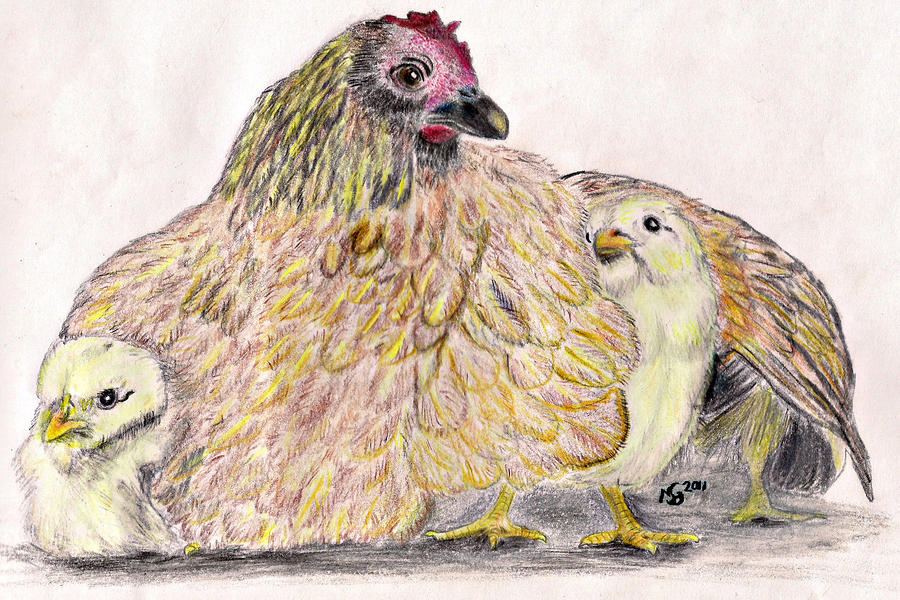
"O Jerusalem, Jerusalem, you who kill the prophets and stone those sent to you, how often I have longed to gather your children together, as a hen gathers her chicks under her wings, but you were not willing!" ~ Luke 13:34 NIV
As an older parent whose daughters are now adults, how many times I have thought of these verses. I have recalled them when I wanted to shelter my children from despair, from hurts, from disappointments and failures, from criticism, injustice or any hateful thing that came their way. But how many times did I quote this verse to them when they were children, or even now as they are adults? Not once that I can remember.
And for that I grieve - that I did not take the time to use those teaching opportunities to share God's love with them. Now I only ask that the Father cover me with His forgiveness, and allow me to go forth in confidence.
The verse was in reference to Jerusalem, and can be read following the break: