Here are a few pictures of Vail and the area around Stapleton, including friend Kathy who did not want her picture taken:


The Snuggles Project was founded by our president and founder, Rae French, in 1996 because of her heartfelt need to do something for the innocent victims who find themselves in animal shelters without a bit of comfort to call their own. Picturing them in their hard cold cells made her heart ache to do something to help. So she got the idea of security blankets for shelter animals. The security blankets are called "Snuggles." Each animal would get a Snuggle to cuddle up with to feel warmth and comfort. Most shelter animals are kept in areas with stainless steel braces and hard plastic flooring or even bare concrete floors. The Snuggles would allow them to have a little reprieve from the coldness of the pen they are kept in.If you are interested in helping out in this compassionate endeavor, go here for a free blanket pattern, courtesy of The Snuggle Project.

clapotis (from French: "lapping of water") is a non-breaking standing wave pattern, caused for example, by the reflection of a traveling surface wave train from a near vertical shoreline like a breakwater, seawall or steep cliff. The resulting clapotic wave does not travel horizontally, but has a fixed pattern of nodes and antinodes.
French women are known for wearing scarves. Starting in September and until summer arrives, this is a most important accessory. The scarf may be striped or patterned, colorful, wrinkled and is much bigger than the scarves you probably have. Women just wrap the scarf around their neck in a "Je suis belle et ça ne demande aucun effort*" sort of way and off they go.
Since I have lived in Paris, I have realized that these ladies are on to something. I find I am much warmer wearing a scarf, even if I’m not wearing a jacket, so here is my knit version of the French scarf. It’s knit on the bias so the variegated yarn makes diagonal stripes and stitches are carefully dropped to make a pattern in the opposite direction. This creates a scarf which tends to be a little more of a parallelogram than a rectangle, but I promise, it’s nice that way.

 Daughter Heidy is showcasing the needlework. Its finished size is 80" x 36". Phew.
The Faroese Shawl takes its title from the Faroe Islands that are northwest of Scotland and halfway between Iceland and Norway.
Artisans from that area ... "here in quiet homes, often far from the nearest neighbor, gossimer fine wool is transformed into cobweb-like beauty..." (from Rae Compton, The Complete Book of Traditional Knitting).
This was a fairly difficult endeavor, but worth the effort for future chilly evenings.


And cucumbers, crisp, cool white ice
in the heart of August, month of fire.
And peas in their delicate slippers,
little green boats, a string of beads,
repeating, repeating.
And sunflowers, nodding at night,
then rising to shout hallelujah! at noon.
All over the garden, the whisper of leaves
passing secrets and gossip, making assignations.
All of the vegetables bask in the sun,
languorous as lizards.
Quick, before the frost puts out
its green light, praise these vegetables,
earth's voluptuaries,
praise what comes from the dirt.

...you save your pennies and splurge on a glorious yarn, taking your time to knit an equally glorious gift from it. You try to find a yarn that, even in its natural state, whispers sweet nothings into the ears of its wearer.It was a pleasure to work with this lovely fiber; the foundation designer yarn was combined with another mulberry colored washable wool (larger stripes) to knit up this larger version of the Baby Surprise Jacket (courtesy of Elizabeth Zimmerman's 1968 pattern):
 A third pinkish-burgundy colored sock yarn was used in the edging of the jacket, finished off with an attached I cord binding and coordinating pink heart shaped buttons. Size 9 circular needles were used, and this sweater turned out to be about an 18 month size.
This is my second Ravelry sweater completed with the help of a forum on this group. Baby Ella Anne, whose mama said she likes to dress Ella in pinks and purples, should be toasty warm this winter in this little jacket made especially for her by her Auntie Nancy.

I am using this idea to add a unique touch to an existing ivory colored camisole. (pictures tomorrow if this works out!)
Thank you so much, Dorothy, for passing this needlework on to me.
 This time of year, lavender is in bloom. Gorgeous! I was fortunate enough to see fields of lavender in bloom in both the state of Hawaii and in Provence (France) while on vacations. The sight of those flowers was breathtaking with surreal colors of purple waving across cultivated fields.
 The picture of a doily sachet and information about making easy paper sachet packets was first published by All Freecrafts. Here is what you need to make the sachet from paper:
Because I am now a pig in heaven with wonderfully scented Colorado lavender, courtesy of my friend Ronn, I added lavender to the sachets. They are tucked away ready to be used for little presents for friends, while currently bringing back memories of prior vistas of lavender fields.
2 Round paper doilies [5 to 6 inches]
Rose pattern rubber stamp
Heart pattern rubber stamp
Gold stamping ink
Gold paint pen
Clear drying craft glue
Cotton balls
Red and green pencils
Making the sachet:
Rubber stamp images on each of the two round paper doily with gold ink. Allow the ink to dry. Using colouring pencils, colour the rose and leaf areas of the stamped images.
With wrong sides of the paper doily together, glue together around the outer edge, leaving an opening of approximately two inches. Allow the glue to dry completely. A glue stick will work for this as well as any clear drying craft glue.
Spray a few cotton balls with cologne or add a few drops of essential oil. Place the cotton balls inside the doily sachet and glue the opening closed.
 The pattern for the sock is from Becca at A Hard Days Knit. She says:
Can't wait to see how they turn out. Thank you for the Ty Dy Sock pattern, Becca.No more socks that don’t fit! It took me years to perfect the best fitting socks. I love just plain stockinette socks in fun stripey yarn ( I think they fit the best and they are great for knitting while watching television and you can take them anywhere).
This is a very basic pattern and is intended as a guide for knitters who already have some sock knitting experience.


The birds and hearts were copied from Sue's Tree House, cool designs for diverse uses.
This design was drawn up atop a linen handkerchief, embroidered, and ironed atop Wonder Under before being appliqued onto the blouse. The blouse was a very thin cotton, so adding the embroidered images helped with the "see-through" issue.
Here is a vest repurposed with appliques and embroidery:

This is a blog you might like to visit; it has lots of vintage items: Emmamyrtle's Blog.
Thundershirt is a proven solution for most types of dogs coping with thunderstorm and noise anxiety. And no training is required! Simply slip on Thundershirt and watch the symptoms disappear. The price of Thundershirt is less than a single visit to the vets, and just one Thundershirt will treat your dog's anxiety for a lifetime. No drugs or training needed! Perfect for thunderstorm, noise anxiety, fireworks, vacuum noise or camera flash anxiety. Thundershirt (patent pending) does the following for most dogs suffering from noise anxiety: 1) The physical sensation of wearing Thundershirt distracts the dog from focusing on her fears, and 2) Being wrapped in a Thundershirt gives the dog a feeling of safety and comfort. Soon after putting on her Thundershirt, your dog will likely settle down and relax. Many dogs will lie down and weather the storms with little to no further symptoms of noise anxiety.
From a more scientific perspective, according to neurobiologists, many types of traumas can cause nerve damage, leading to dogs having exaggerated responses to stimuli such as loud noises. Applying constantly maintained pressure with Thundershirt provides an unchanging, quieting stimulus that allows the dog to relax

I have to admit, I was a bit hesitant when I purchased this product on the recommendation of a friend. Ten minutes after putting it on my dog, I became a believer. Not only was my dog calmer, but for the first time ever, he didn't wake the neighborhood with his howling and barking. I don't know how it works, but it does!!! I highly recommend this product for any dog that has a fear of thunder or other loud noises.
 This is a work shirt which I repurposed, using nine different pieces of vintage embroidery found on antique table runners and linen napkins to cover the front panels, back yoke and sleeve cuffs. Some of the embroidery was so old it was frayed, so using the Wonder Under product helped insure fabric stability.
And here is a picture of a new pattern I am working on for application to the front of a plain white blouse, followed by embroidery work in various stitches, finishing off with crayon coloring on the shirt:
 The fairie was sketched by Michelle at Michelle's Blog. She will dress up that shirt front, for sure.
After it is embroidered, I will color it with crayons using this technique from the TintedLinenTutorial:
Thanks again to Tracy at GiggleFace Studios for her tutorial on using crayons on fabric....Trace your pattern onto your fabric very lightly with a pencil or a water soluble marker... Tape the fabric down on the corners to a flat smooth surface.Take out your crayons and color! You may need to color a little harder in the fabric because the ironing will soften the crayon. Experiment with shading to add depth or only color a few things to really make a bold statement. Try to color in the same direction because the strokes will show (unless this is the effect you are trying to achieve).
When you are satisfied with yourself, sandwich the fabric between 2 pieces of plain paper. Set your iron to the "cotton" setting. Press the fabric sandwich slowly and smoothly. This will 'set' the crayon. You may need to press a few times to get the results you want. I did mine a few times to soften and melt the crayon for a smoother effect. From this point you can either back the design with another piece of fabric or place in an embroidery hoop. Embroider your heart away! Use different stitches,beads, sequins, etc.
 Consider this free advertisement for Knitters Review, because that weekly magazine is a wealth of information. It has "timely, in-depth, and insightful reviews for knitting and fiber enthusiasts", and is chock full of goodies, all relating to products dealing with fiber.
I love working with different animal fibers. New blogger friend, Brenda at Split Rock Ranch, raises, trains, shears, and sells llama furs, and she even dyes and spins their fiber. One smart cookie, that Brenda. Here is what she sold me yesterday:What do you knit for someone truly special? If you can, you save your pennies and splurge on a glorious yarn, taking your time to knit an equally glorious gift from it. You try to find a yarn that, even in its natural state, whispers sweet nothings into the ears of its wearer.
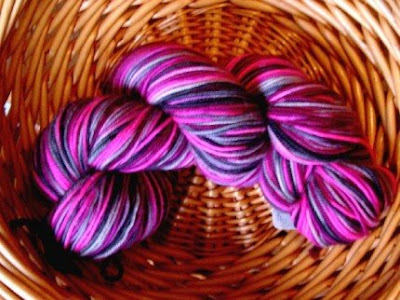
Llama fiber will be a new experience (in my limited repertoire, at least) to use in knitting winter garments, so come on cold weather... those knitting needles are anxious for a workout with animal fibers.Llama and alpaca are hollow fibers so they trap air and act as an insulator, very much like down. They are best spun fine(r) and knitted in smaller projects like scarves, hats, etc. unless they are spun laceweight. Because they don’t have “memory” like sheep’s wool, they can tend to get stretched out of shape if your garment is too bulky and heavy.
An open-work shawl done in llama wool would be gorgeous. Tip to make that skein stretch a bit farther - use big needles! That leaves a bit of space between stitches so the garment doesn’t get too hot.


 OK, now it is sketched out.
 The center of the magenta colored ornament at the lower right of the picture was made with a small crochet hook and sock yarn, again using the same technique. Then the small pink rose was sewn into the center of the larger crocheted flower. If made about the size of a US quarter, they will look cute on a baby sweater.

Our mission, and what you should and should not expect from us:
1) To foster competitive Scrabble® play.
... our regulars include the highest percentage of the most skilled regular club attendees in NYC.
... all are welcome, we also have plenty of players at various lower levels of skill. Our players range from teenagers to octogenarians; from writers to chefs to dog-walkers. We also let in braggarts and blowhards, but we don't let them out without giving them their comeuppance.
... it's not a social club that also plays Scrabble, it's a Scrabble club that occasionally also fosters socialization outside of the club.
... you come to us because you're looking for a stimulating challenge, a genuine battle of wits, as you've run out of that among your relatives, friends and neighbors.
... we're not a substitute for something missing in your life, tho many do view competing at Scrabble as a form of therapy; we're the focal point of something you already had at least a minor obsession with.
... we're not going to take it easy on you just because you're a "beginner" -- lots of players are developing their skills online these days before they ever come in for face-to-face play, so we can no longer make assumptions that you're unskilled just because we've never seen you before. But if you are relatively unskilled, we hope you're mature enough to take a beating or several and view getting your revenge as an intellectual challenge, and we will gladly show you a few ideas to help you improve quickly.
2) To increase your awareness of the vastity of language, the variation in North American usage of English, and the amount of international culture it now absorbs.
... your degree in English doesn't mean you know the only way to use English, and more words than the average bear; our dictionary is THE dictionary, arguing with it is tiresome and pointless. Our dog-walker will defeat a surprisingly high percentage of English professors and scriptwriters, and he’s not even Hank Azaria.
3) To increase your understanding of how to mathematically optimize the application of your vocabulary and spelling skills in conjunction with values of the letter set and the geometry of the game board.
What a hoot. Those New Yorkers know how to say it.
This will be my third national tournament to attend. Over the past 13 years, I have competed in about 25 sanctioned tourneys; too bad my scores don't reflect that I am anything other than your average nerdy, obsessed, Scrabble player.

So husband hit four out of the ten points. How geeky is your mate?Finding the best deals in grocery stores. Not everyone will notice that, even though the 12-pack of Coke cans is on sale for $3, it’s still not as good a deal per unit as the 2-liter bottle at its regular price of $1.29. But a geek will — we knew math skills would come in handy one day, even if nobody else thought so!
Not being glued to the TV when a sports event is on. Now, I realize that plenty of geeks love sports (I’m a baseball fan myself). But as a general rule, the typical geek is much less inclined than the typical non-geek (particularly the male variety thereof) to insist on watching every minute of every game their favorite team plays in a season
Providing technical support to friends and family. We may grumble and sigh about doing it so often, and we may get frustrated when our in-laws don’t know the difference between WEP and WPA. But don’t be fooled: We actually enjoy this on some level. Everyone — geeks included — likes to be needed, and geeks also love few things more than to look like an expert. So this is really a win-win: The non-geeks get their computers and gadgets fixed, and the geeks get to look like geniuses for doing things that wouldn’t impress a single one of their geek friends.
Cooking. I’m sure there are lots of geeks who don’t like to cook, or don’t think they do, but if you’re one such, I humbly suggest you give it another few tries. Cooking has so much geek potential it’s a wonder it’s not considered a “typical” geek activity: you’ve got lots of different ingredients to pick from, measuring implements, heat, chemical reactions, gadgets galore and a great deal of nuance. Plus, it’s like doing scientific experiments where you get to eat the results! And there are few things more endearing to potential life partners than being able to cook well (and not just on a grill).
 Daughter Julie's husband, Jack, is a radio ham operator. He is always coming up with conversation on his radio and making contact with people from all over the world. There is a whole lot out there of which I know nothing, ham radios being one such subject.
 USA, KA4WWN, JOHN P HENIFORD, 1729 CRICKET RUN RD, YORK, SC 29745; from his email:
Enough said. Thanks, Jack, for sharing your expertise.My friend Joe, ham operator KP2AE, Extra Class licensee, says, "there's some science in it...". He means whatever contacts you get depend on the Ionosphere. We use High Frequency radio (HF) from 1.3 megahertz to 50 megahertz for long distance contacts. That part of the spectrum doesn't travel in straight line-of-sight paths - it bounces off the Ionosphere, maybe multiple times.
A lot of things affect how many bounces there will be. One factor over a period of years is sunspots. They are solar storms, and they cause heightened ionization in our atmosphere, and therefore , more radio bouncing in HF. Actually we're still in one of the seven - year low periods, probably starting to come out of it so long contacts should soon become more frequent. Medium long wave radio gets the bouncing too, but not as much. That's regular broadcast radio. Very High Frequency, like police use, hardly gets it at all except sometimes it might. Long wave , below half a megahertz, doesn't get it, it's used for sending code to submarines and other special applications. Some hams can use Extra High Frequency, up in the gigahertz range, that can go straight through the atmosphere and bounce off the moon.
I said Joe is an Extra Class. I'm a General Class. Joe passed a more difficult test than I did. The Federal government produces the tests, and we're licensed by the Feds. Some of the things we're allowed to do could interfere with government radio applications, so we have to follow the rules which have the force of law, to avoid such. CB used to be regulated, but there's so much trash on it I think they just gave up the regulation, and should probably abolish it..Family Radio, like campers use, as you know, is regulated only by power limitations. The Feds assign call signs, too. Joe's indicates he was licensed in the US Virgin Islands when he worked there, and he retains that call. Mine shows that I was licensed in the Southeastern US.
So, there you go - ham radio in a nutshell.
 Walking along and listening to podcasts this morning, NPR Science Friday had an interesting story about how one guy on the East Coast of the US (Pennsylvania) had ripped out all the grass in his lawn and replaced it with moss over forty years ago. Note that one must have a shady lawn in order to accomplish this green feat.
 This is one of our front yard day lilies blooming. Yellows, reds, rust colors, oranges, burnt sienna and greens set it off. The bloom lasts less than a day, so you have to admire it when you can.
Step 1: Outline the day lily in pencils, adding in some leaves and filling in the background with some color: Stretched canvas painting continues after a week of work with further definition of petals:

 It is about half finished at this point. It is 30" x 40", and there is still lots to do on it. Grounding the leaves from the base is a hurdle that needs to be overcome. Any helpful suggestions?

One of his siblings still in the nest about an hour ago:

Their size is deceptive in the picture, as they appear larger than their actual size of a silver quarter coin. That bird poop around the perimenter of the nest is disgusting, but they don't seem to mind.
This YouTube site, http://www.youtube.com/watch?v=IMJIFYcru-E, shows 10 minutes of finches in their nest.
This mixture is similar (or the same) to that green dipping sauce served with appetizers at Indian restaurants. It is delicious with Frito's!1 bunch fresh mint leaves
2 green chillies
1 tbsp tamarind pulp
Salt to taste, a little water
How to make mint (pudina) chutney :
To make tamarind pulp soak a little tamarind in water and keep aside for 2 hours. Then strain the mixture in a bowl with the help of a spoon. To make tamarind juice add a little water to the pulp. These days ready made pulp is available in the market.Wash the mint leaves well. Grind it to a smooth paste with green chillies, salt and tamarind juice. You can add water if the mixture is thick.
Here is a picture of this refreshing summer pea salad with mint sauce:A bright green salad of sugar snap peas and sweet green peas in a light, mint dressing. Cook Time: 2 minutes
Ingredients:
2 1/2 cups frozen peas
1 pound sugar snap peas, strings removed
2 tsp sugar
2 tbsp
white wine vinegar
1 tbsp extra-virgin olive oil
1 tbsp lemon juice
1/4 cup freshly chopped mintPreparation: Bring a large pot of water to a boil. Add frozen peas and snap peas, and cook for 2 minutes. Drain and rinse immediately with cold water to stop cooking, and empty peas into a large bowl. In a small bowl, combine sugar, white wine vinegar, olive oil lemon juice and mint. Drizzle over peas. Toss, then refrigerate for 2 hours. Serves 8
Per Serving: Calories 83, Calories from Fat 17, Total Fat 2g (sat 0.2g),
Cholesterol 0mg, Sodium 53mg, Carbohydrate 12.6g, Fiber 3.8g, Protein 4g

Another summer salad shown below is my husband's invention and can be found at his weblog recipe for pasta primavera salad. (no mint in this salad)


 It should end up quite large, if perseverance continues, roughly five feet at the top edge tapering down to a modified ending point four feet from the edging border.
The Faroese Shawl was named by Marily van Keppel as she translated the pattern from the Faroese language and has it published in A Gathering of Lace (complied by Meg Swansen). This shawl has its own thread on ravelery. Moderator Diane at Bella Vita Farm has been a great help in interpreting this pattern. Thanks, Diane.
The identification of these three finches of the Carpodacus genus can be extremely difficult. Each species is about the same size and shape, each is colored red with varying degrees of brown streaking, and each is common to feeder areas. What's more, the ranges of these birds overlap quite a bit, primarily owing to the ubiquitous distribution of the House Finch.


 I have been feeding finches for about two months from one of those bird feeder net socks. The feeder sock is about five feet from the honeysuckle arbor, so it is a convenient diner for mom and dad and soon-to-be kiddos. There are four eggs in the nest, and I was very careful in not leaving my scent too near the nest.
Catherine wrote this blog post about wrens nesting in cactus, and it spurred me to get a ladder out and look up into the honeysuckle branches where finches seem to be nesting. Sure enough, there were the pretty little eggs in a wee little nest.
It takes 21 days for chicken eggs to hatch, but only 14-16 days, according to Yahoo Answers, for finch eggs to hatch.
What is hatching in your neighborhood?


 Incorporating vintage hankies on pillows top: